The Phillies’ Inaugural Opening Day
 By Bob Warrington
The inaugural Opening Day at Citizens Bank Park (CBP) on April 12, 2004 marked a milestone in Phillies’ history. One must go all the way back to April 30, 1887 to find a similar event in the franchise’s history.
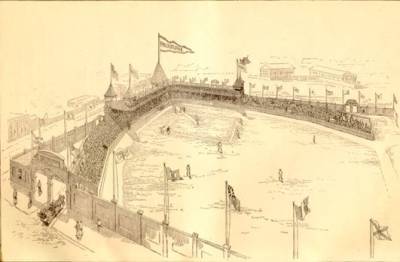
On that date, the Phillies played their first game ever at Philadelphia Ball Park. Like CBP, Philadelphia Ball Park was a baseball-only ballpark built by the club at a new location. The team played there from 1887 until 1938, when the Phillies became tenants of the Athletics at the already-existing Shibe Park. The Phillies moved to new Veterans Stadium in 1971, but that was a multi-purpose facility built by the City of Philadelphia for baseball and football. April 12, 2004 was a memorable moment in Philadelphia baseball history, just as it was on April 30, 1887.
A New Ballpark is Born
When the Worcester Brown Stockings franchise was moved to Philadelphia after the 1882 season, new club president Alfred J. Reach leased a tract of ground, bounded by 24th and 25th Streets, Columbia Avenue, and Ridge Avenue, for his ballpark. The grounds were cleared, playing field leveled and resodded, and a three-section wooden grandstand constructed. Christened Recreation Park and built to hold 6,500 spectators, the ballfield served as the Phillies home from 1883-1886. The ballpark, however, quickly became obsolete and often could not handle the crowds wanting to see the Phillies play. Watching patrons turned away because they could not be seated, Reach became anxious to move into a larger more elegant ballpark that could accommodate a greater number of paying customers.
Reach’s search for a site for his new ballpark landed him on an odd-shaped plot bounded by Broad Street, Lehigh Avenue, 15th Street, and Huntingdon Avenue in North Philadelphia. The location was selected, in part, because of the excellent access it offered to public transportation. The Pennsylvania and Reading Railroad companies could bring crowds of fans to the ballpark from the center of the city and adjoining suburbs, and city passenger railways could carry in the trade from communities like Kensington, Richmond, Frankford, and Bridesburg. A lease of the grounds for ten years with the privilege of purchasing was signed on January 2, 1886, and improvements began at once. It took over 100,000 loads of soil to fill up the gullies, ditches, and holes on the plot, with an additional 20,000 loads needed to bring its sides and ends in gradients with the surrounding streets.
Reach wanted his new ballpark to be a far grander place than the old one. In his words, “I intend to erect a ball park worthy of our team and of which we all may be proud.” Built at a cost of $101,000 and considered the finest ballpark in the nation when it opened, brick was used extensively in Philadelphia Ball Park’s structure, instead of commonly used wood, and it was the first such facility to offer pavilion seating for customers. The massive brick pavilion at the main entrance—dominated on the outside by a central turret 165 feet high and two end turrets 75 feet high—was as revolutionary in ballpark construction as it was medieval in appearance. The pavilion held 5,000 seats, while 7,500 additional customers could be accommodated in the grandstands that extended down the left and right field lines. There were no seats in the outfield.
Although Philadelphia Ball Park would become an object of ridicule over the years and disdained as outmoded when the Phillies abandoned the place—then called Baker Bowl—in 1938, it was, in 1887, the pride of Philadelphia and the envy of other cities. The ballpark had taken over a year to build at a then-enormous price, but all was in ready as the big day approached and the Phillies prepared to stage their inaugural Opening Day—April 30, 1887.
“A Red Letter Day”
There was a great sense of expectation and excitement in Philadelphia as the opening of the Phillies’ new ballpark arrived. The “Philadelphia Inquirer” caught the spirit of the moment when one of its writers noted, “The greatest event in the base ball history of this city will take place today when the opening game will be played on the new grounds of the Philadelphia Club, at Broad and Huntingdon Streets.” The club, recognizing the importance of the event, sent out 2,000 invitations to prominent city politicians, business leaders, and baseball officials. Fully 1,500 were accepted, according to the “Inquirer.” In a spectacle befitting the occasion, Phillies’ players and their opponents, the New York Giants, were paraded in four-wheeled carriages up Broad Street to Philadelphia Ball Park.
Not surprisingly, there were far more people who wanted to see this historic occasion than the ballpark could accommodate. According to a contemporary newspaper account, “There was a scrambling time in getting tickets as lines of men stretched four blocks away from each of the windows where tickets were sold, and some stood in line two hours before they got inside the grounds.” Extra trains and street cars were scheduled to transport the crowds of fans who wanted to attend the event. The seats to hold people were soon filled, so ropes were stretched across the farthest reaches of the outfield to handle thousands of additional patrons. During the game, numerous hits went among these spectators and were declared ground rule doubles. Eventually, nearly 20,000 fans squeezed into Philadelphia Ball Park to witness history in the making. Lieutenant Wolf, Sergeant Egolf, and 25 patrolmen of the Philadelphia Police Department were present to keep order and handle the vast crowd.
Among the notables attending the game were Mayor Edwin Fitler, numerous councilmen, judges, magistrates, state legislators, the postmaster, the president of the Board of Education, the city solicitor, the chief of police, and the deputy city coroner. Prominent officials of the Pennsylvania Railroad rubbed shoulders in special pavilion seating with baseball personages including John B. Day, president of the New York Giants, C. H. Barnie, president of the Brooklyn club, and Lew Simmons, a minstrel show producer and performer who had an interest in the rival Philadelphia Athletics of the American Association. Indeed, the Athletics moved up the starting time of their game that day by several hours so as not to conflict with the Phillies’ Opening Day.
Pre-Game Festivities
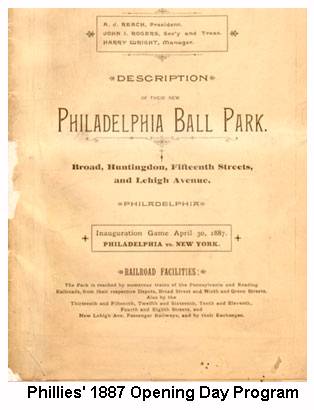
At 3 PM, Professor J.G.S. Beck and his 25-piece Beck’s Military Band began a concert of popular tunes of the era. The program, including works by Brooke, Brahams, Waldteufel, Jacobowski, and Sullivan, started with the rousing “March-Champions!” and ended with the equally invigorating “Gallop-Take This!.” Each selection was met with loud applause from the audience. At 3:30 PM, team president Al Reach and manager Harry Wright appeared on the field, and the crowd gave them three rousing cheers. The Philadelphia and New York players then emerged from their dressing rooms and marched with Reach and Wright to the flagstaff in centerfield.
Upon reaching their destination, the players formed ranks, and Reach and Wright walked between them to the flagpole. Wright withdrew the American Flag he had tucked under his arm, attached it to the rope, and raised Old Glory smartly to the top. As the flag unfurled, according to one newspaper account, “The crowd grew wild with excitement, and cheer after cheer rent the air.” Describing the atmosphere for its readers, the “Inquirer” observed, “It was a pretty sight not easily forgotten. Twelve hundred ladies were in the private boxes and the pavilion, and their bright costumes and fluttering little shawls and handkerchiefs added a needed color to the scene.”
Reach, Wright, and the players returned to the home plate area to conclude the pre-game ceremonies. Throughout the festivities, Colonel John I. Rogers, part owner, secretary, and treasurer of the Phillies, stood at the top of the stairs at the main entrance of the pavilion receiving invited guests.
The Game
The omens were all favorable for the Phillies as they took the field at 4 PM to start the game. The team had won the “City Series” against the Philadelphia Athletics of the American Association six games-to-five (one had ended in a tie), by taking the final game of the competition 11-8 on April 22nd. Moreover, starting for the Phillies against the Giants was the great Charlie Ferguson, who had won 57 games for the team over 1884-86, including a 30-9 record in 1886. Hurling for the Giants was Tim Keefe, an outstanding 19th century pitcher who had gone 42-20 for the Giants in 1886 and was well on his way to a Hall of Fame career.
The Phillies, batting first under the rules of the day, started the game in a remarkable fashion. The first nine batters all hit safely off Keefe as the team scored nine runs to take a lead that it would never relinquish. The Giants came back in their half of the first to cut the lead almost in half—scoring four runs off Ferguson. In the third, the Phillies added six more runs to their tally, going ahead 15-4. The Giants, however, nipped away at the lead, closing the difference to 15-9 by the end of the seventh inning. In the top of the eighth, the Philadelphia club scored four more runs to jump its total to 19. The Giants got one back in the bottom of the eighth to make it 19-10, and had only two outs when the game was stopped on account of darkness. According to the rules then in effect, the score reverted to the last completed inning (the seventh), thereby entering the game’s final in the record book as 15-9.
With almost 30 runs scored in the game by the bottom of the eighth inning, you would think that a host of pitchers appeared in the game for both teams, but such was not the case in 1887. The two starting pitchers toiled throughout the entire contest. Indeed, neither team made a single substitution. The same men who started the game for the Phillies and Giants were still playing when the game was called on account of darkness. Phillies left fielder George Wood earned himself a spot in baseball lore by becoming the first person to hit a home run in Philadelphia Ball Park, smacking the ball over the right field fence. By doing so, he won a suit of clothes.
The 1887 Season in Perspective
The 1887 season marked an important milestone for the Phillies. It marked the first time the club was in serious contention for the National League pennant. The team finished with a highly respectable record of 75-48 (.610 winning percentage), but was edged out of the top spot by the Detroit Wolverines, who finished three-and-a-half games ahead at 79-45.
Team nicknames were not as uniformly applied in the 19th century, as is the case today. Newspaper accounts from that period refer to the club interchangeably as the “Phillies,” the “Philadelphias,” and more formally as the “Philadelphia Club.” During its first years of existence, the team was also referred to routinely by the press as the “Quakers,” but that moniker had died out for the most part by 1887.
On a sad note, Charlie Ferguson, who won the first game for the Phillies at Philadelphia Ball Park, died almost a year to the day that the contest took place. Ferguson contracted typhoid fever during spring training in 1888 and succumbed to the disease on April 29th, one day short of the first anniversary of the inaugural Opening Day at the Phillies new ballpark.