Shibe Park’s Grand Opening
By Bob Warrington
Introduction
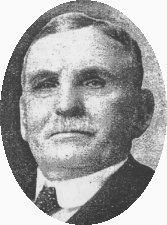
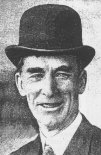
When the Philadelphia Athletics were created in 1901 as one of the clubs in the newly formed American League, the team had an immediate need for a ballpark in which to play its home games. Athletics’ Manager Connie Mack found a suitable vacant lot and took out a 10-year lease on the property. Bordered by 29th Street, Columbia Avenue, 30th Street, and Oxford Street in North Philadelphia, the new ballpark was christened Columbia Park and would serve as the home of the Athletics through the 1908 season.
Hastily erected at a cost of $35,000, Columbia Park had a seating capacity of only 9,500. Wooden grandstands extended on either side of the field from home plate to first and third bases. Open bleachers continued from the grandstands down both foul lines. While the Athletics drew well, the little wooden ballpark’s meager seating capacity didn’t hold enough people to suit Mack or team President Ben Shibe. The ballpark’s gates had to be shut often when all the seats had been sold, leaving thousands of fans on the outside. This was especially true during 1902 and 1905 seasons when the Athletics won American League Championships.
Envisioning high profits based on larger crowds at a bigger ballpark, the A’s abandoned Columbia Park after the 1908 season, moving to the newly constructed Shibe Park. This article presents a “you are there” account of what it was like to be at Shibe Park when the Philadelphia Athletics played their first Opening Day game at the ballpark on April 12, 1909.
The New Ballpark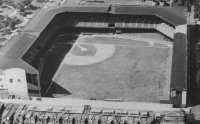
Opening Day 1909 for the Philadelphia Athletics is here and you want to be there. It’s not every year that the first ballpark built solely of steel and concrete is inaugurated. When you arrive at Shibe Park, you’ll discover that it’s totally unlike Columbia Park. Built in one year at a cost of just over $300,000, Shibe Park has seats for 23,000 and parking (under the bleachers) for 200 cars. Horse-drawn wagons carried 15,000 loads of dirt from the site—bounded by 21st Street, Lehigh Avenue, 20th Street, and Somerset Street—as part of the construction. Sod has been removed from Columbia Park to cover the playing field of the new ballpark.
Shibe Park, moreover, is a dignified palace with rusticated bases, composite columns, arched windows and vaultings, ornamental scrollwork, and a fabulous French Renaissance tower with cupola that houses the offices of team Vice President John Shibe and A’s Manager Connie Mack.
It’s hard to believe as you view the magnificence of the ballpark that only a year ago the area consisted of vacant lots, woods, SPCA kennels, and the notorious Philadelphia Hospital for Contagious Diseases at 22nd Street and Lehigh Avenue. Of course, that made the land cheap for A’s President Ben Shibe to purchase, and some even suspect that he knew of the city’s plans to close the hospital when he first started acquiring land in 1908 to build the ballpark. Indeed, the hospital will close in June 1909 and be demolished in 1911.
When you arrive inside Shibe Park, you’ll notice immediately that its dimensions are generous with left field at 378 feet from home plate, right field at 340 feet, and center field at 515 feet. Where you sit depends on your ticket. A double-decked grandstand hugs the infield in a half-hexagon, and open-decked bleachers continue down the rest of both foul lines. There are no stands in the outfield, but you might be one of the 10,000 people who pay to stand behind ropes in the outfield to see the action.
For either one dollar or fifty cents—depending on the seat—you can be one of the 10,000 people who sit in the grandstand. Just walk from the ticket window through the 24-foot diameter lobby at the base of the tower up a 21-foot wide stairway to the main grandstand promenade. An usher will help you find your seat. Note that Shibe Park’s grandstand features another innovation—folding chairs.
For a quarter, you can be one of the 13,000 fans who sit on the 8-inch wide pine planks that make up the bleachers. When you buy your ticket, just walk through the lobby at the base of the tower and head for one of the 14-foot wide concourses to the north and east that will guide you to the bleachers. Souvenir programs are available for 10 cents apiece.
Opening Day Activities
You’ve got to get in line early for tickets to the game. George McFadden, the first person to arrive at the ticket window, gets there at 7 AM even though the widow doesn’t open until noon. McFadden will later turn down an offer of $35.00 for his ticket—big money in 1909. Amazingly, 30,162 will pay admission to get into the game. The Philadelphia Inquirer calls it “the greatest crowd that has ever witnessed a baseball game” and notes that in addition to the paying crowd, “5,000 others gained admission by invitation, by scaling the high walls, or by pressing into the grounds when the gates were rushed by surging crowds.”
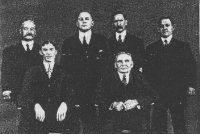
Directors of the American Base Ball Club of Philadelphia
You don’t want to be part of the melee that erupts when there are no more tickets available. Another 30,000 people are still outside the ballpark when the gates close, and angry fans try to storm the gates and pelt the ticket windows with rocks before police break up the commotion.
If you’re in your seat by 1 PM, you can hear the First Regiment Band play a concert. The Third Regiment Band will also play a series of musical compositions in a later performance. Some of the songs played by the bands include: The Three Twins; The Glow Worm; The Talk of New York; and Flying Artillery. At 2:30 PM, Frederick C. Yockel will lead the crowd in singing America. Then, the Athletics and the Boston Red Sox will march behind the bands to center field where Old Glory will be raised by Ben Shibe and American League President Ban Johnson while the bands play The Star-Spangled Banner.
Philadelphia Mayor John Reyborn is in attendance with other city officials, baseball dignitaries and even a few Phillies players. The honor of throwing out the first ball goes to Mayor Reyborn.
The Baseball Game
Pitching for the Athletics is their ace left-hander, “Gettysburg” Eddie Plank. The A’s lineup in this inaugural game is Hartsel {LF}, Nicholls {3B}, Collins {2B}, Murphy {RF}, Davis {1B}, Strunk {CF}, McInnis {SS}, Powers {C} and Plank.
Eddie Plank delivers the first pitch of the game to Red Sox second baseman Amby McConnell, and the contest is underway at 3 PM. The A’s get off to a quick 1-0 lead in the first inning and never look back. The team hammers out an 8-1 victory as Plank scatters 6 hits, strikes out 8 and walks 4. The Athletics pummel losing pitcher Frank Arellanes for 13 hits. Danny Murphy gets 4 of those hits, and Simon Nicholls records 3 while scoring 4 runs for the A’s.
Afterwards
As the Evening Bulletin reports, “It was a great day for Philadelphia in the baseball world, it was a great day for the fans, a most profitable one for the owners of Shibe Park, and a grand start for the Athletics. The attendance will probably go on the record as the largest in the history of baseball.”
If you make it to the ballpark on Opening Day or sometime thereafter, you’ll be one of 674,915 in attendance at Shibe Park during the 1909 season. The Athletics have a fine year, finishing second to the much-hated Detroit Tigers—3 ½ games back. Moreover, the Athletics stand on the threshold of their first dynasty. The team will bring Philadelphia its first World Series Championship in 1910 with more to follow.
Sources
Material was taken from the following books to recreate Opening Day 1909 at Shibe Park: Bruce Kuklick, To Every Thing a Season: Shibe Park and Urban Philadelphia; Frederick Lieb, Connie Mack: Grand Old Man of Baseball; Rich Westcott, Philadelphia’s Old Ballpark’s; and Michael Gershman, Diamonds: The Evolution of the Ballpark.
My father came to Philadelphia from Warsaw, NY to play for Mr Cobb during that era.(against my grandfather’s wishes). He was underage and needed his father’s signature to try out for the team. I grew up hearing many stories about Philadelphia at that time. His name was Herbert (Bert) Williams, but I know little else about his time here. He worked for Dupont during the off season and married my mother in 1919.