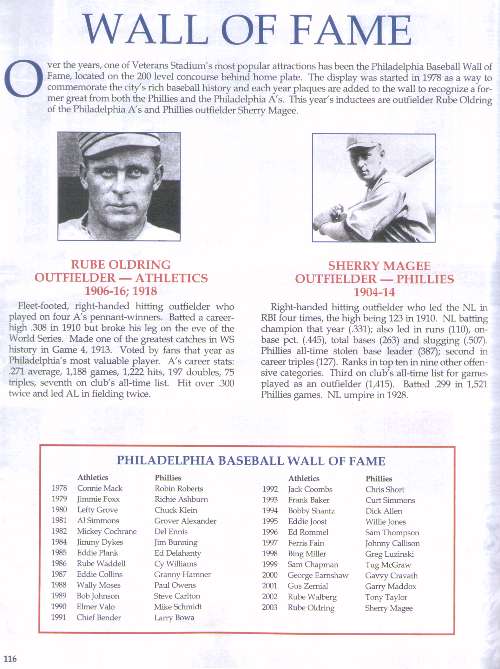
Rube Heads to Phillies Wall of Fame
 Over the years, one of Veterans Stadium’s most popular attractions has been the Philadelphia Baseball Wall of Fame, located on the 200 level concourse behind home plate. The display was started in 1978 as a way to commemorate the city’s rich baseball history and each year plaques are added to the wall to recognize a former great from both the Phillies and the Philadelphia A’s.
This year’s inductees are outfielder Rube Oldring of the Philadelphia A’s and Phillies outfielder Sherry Magee. Relatives of both former players were at the Vet on Saturday, June 8, 2003 to receive a plaque that duplicates the ones on display. Since this is the last year of Veterans Stadium, Oldring’s plaque will be the final one for the A’s. Going forward, the Phillies Wall of Fame will continue in Ashburn Alley when the new ballpark opens in April.
RUBE OLDRING
OUTFIELDER — ATHLETICS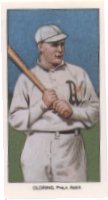
1906-16; 1918
Fleet-footed, right-handed hitting outfielder who played on four A’s pennant-winners. Batted a career-high .308 in 1910 but broke his leg on the eve of the World Series. Made one of the greatest catches in WS history in Game 4, 1913. Voted by fans that year as Philadelphia’s most valuable player. A’s career stats: .271 average, 1,188 games, 1,222 hits, 197 doubles, 75 triples, seventh on club’s all-time list. Hit over .300 twice and led AL in fielding twice.
SHERRY MAGEE
OUTFIELDER — PHILLIES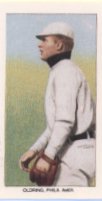
1904-14
Right-handed hitting outfielder who led the NL in RBI four times, the high being 123 in 1910. NL batting champion that year (.331); also led in runs (110), on-base pct. (.445), total bases (263) and slugging (.507). Phillies all-time stolen base leader (387); second in career triples (127). Ranks in top ten in nine other offensive categories. Third on club’s all-time list for games played as an outfielder (1,415). Batted .299 in 1,521 Phillies games. NL umpire in 1928.
Rube Oldring: “The Pride of the Left Field Stands”
By Rube Oldring, Jr.
According to an article in the Philadelphia Evening Bulletin in 1930, Ty Cobb once told Rube Oldring, “If I was as fast as you, what a ball player I’d have been!” In 1937, on the occasion of his 75th birthday, when Connie Mack was asked to select his all-time finest Athletics team, he chose Rube Oldring as his left fielder, batting him second in the lineup.
In 1946, Mister Mack credited Oldring with making the greatest catch he ever saw. It was in the 1913 World Series against the New York Giants, Game Four at Shibe Park. Pinch-hitter Moose McCormick cracked a line drive into left center with two runners on base in the fifth inning, but Oldring made a spectacular shoestring catch and held the runners. Chief Bender was pitching for the A’s, and that catch saved the game. The Mackmen went on to defeat the Giants for the championship, four games to one.
With his natural ability, Rube Oldring played thirteen years in the American League. With the exception of 51 games with New York (eight games in 1905 and 43 in 1916), his entire big league career was with Connie Mack and the Athletics. While sometimes overshadowed by the “Hundred Thousand Dollar Infield” of the A’s first dynasty, in 1913 Rube was voted “Most Popular Player in Philadelphia” by the fans and was presented with a Cadillac automobile as a token of their esteem.
Reuben Henry Oldring was born on May 30, 1884, on the west side of New York City. As a kid, Rube played sandlot ball on New York’s east side; at the age of fifteen he made frequent trips on the Courtland Street Ferry to play ball in New Jersey. His first taste of semi-pro ball was with the Ontario team that played at 147th Street and Lennox Avenue in New York City. He went on to play for the Orange, New Jersey, team on Saturdays for five dollars a game. Rube was later picked up by the Hoboken semi-pro team and, after a month there, was recruited to play for Montgomery, Alabama, in the Southern League.
Connie Mack learned of Oldring from the Montgomery manager and purchased his contract for Philadelphia in 1905. In October 1905, Rube played eight regular and two exhibition games at third base for the New York Highlanders. Clark Griffith, managing the Highlanders, was impressed with Oldring’s performance: Rube hit .300, with a triple, a home run, and four stolen bases in his brief appearance with the New Yorkers.
At the conclusion of the 1905 season, the Highlanders attempted to draft Oldring for the following year. His contract, however, was owned by Philadelphia, and the New York club was stymied.
Oldring began playing regularly for Connie Mack in August 1906. Initially a third baseman, Rube had a powerful arm and frequently overthrew first base. One day Mr. Mack decided to move Oldring to center field, where that strong arm would become an asset. Rube had the ability to get a good jump on the ball, he was fast, and he made few errors. He was later moved to left field, where he played until his retirement after the 1916 season. (He was called out of retirement in 1918 and played 49 more games for Connie Mack.)
Rube led the American League in fielding percentage in 1910, 1911, and 1915. In 1913 he stole 40 bases out of his career total of 197. He hit fourteen triples two years in a row, 1910 and 1911, and had a career total of 77. Oldring appeared in 1237 games and collected 1268 hits for a lifetime batting average of .270.
Oldring, Cobb, and Shoeless Joe Jackson were selected as the three outfielders for the 1914 All-American team by a Boston newspaper. Baseball Magazine that year called Rube “as good a fielder as Ty Cobb himself,” “a better baserunner than Jackson,” and “a heavier hitter than Clyde Milan.” After he left the major leagues, Rube Oldring became the player-manager of the Richmond Colts of the Virginia League in 1919, leading his club to a pennant. Over the next five years, he managed Suffolk in the Virginia League, Seattle in the Pacific Coast League, New Haven in the Eastern League in 1922, and the Wilson club in the Carolina League in 1923 and 1924. Oldring retired at the close of the 1924 season but was coaxed back into the game for the 1926 season by Richmond and again led the Colts to the Virginia League championship. After that 1926 season, the 42-year-old Oldring retired from baseball for good, buying a 51-acre farm near Bridgeton, New Jersey, and settling into the life of a “gentleman farmer.”
However, Rube never lost his love for the game. He was instrumental in organizing Little League baseball at its outset in the Bridgeton and Cumberland County area and was a regular at ball fields around the area, counseling, teaching, and mentoring countless young baseball enthusiasts.
Rube Oldring’s life came to an end on September 9, 1961, from an acute coronary occlusion at the age of 77, at his home in Roadstown, New Jersey. But he was not forgotten. In 1991 he was named to the South Jersey Hall of Fame by the Camden County Hot Stovers, and the following year he was inducted, along with his longtime friend Leon “Goose” Goslin, into the South Jersey All Sports Hall of Fame.
On August 9, 1997, at the Dreams Park Little League Complex in Cooperstown, New York, “Rube Oldring Field” was dedicated in his honor for his contributions to baseball, especially to organized youth baseball.
Today, as a testament to his contributions to baseball, the Athletics, and Philadelphia’s first baseball dynasty, we feel it appropriate to support Rube Oldring for inclusion on the Veterans Stadium Wall of Fame. We are sure Mr. Mack, Chief Bender, Frank Baker, Eddie Collins, Rube Waddell, Eddie Plank, and Jack Coombs would approve of our choice.