JIMMY DYKES…A PHILADELPHIA STORY
 by Dale B. Smith
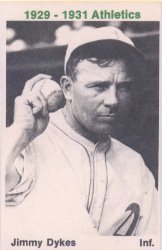
James Joseph Dykes was born November 10, 1896 in the City of Brotherly Love. Nearly 80 years later he would die there on June 15, 1976, just days short of the nation’s 200th anniversary. What he did in between those years speaks well of Philadelphia’s native son.
Jimmy Dykes seemed to be born to play baseball in his hometown. He did just that starting in 1918 at the age of 21, joining the last place Philadelphia Athletics in a year that saw many players, including Dykes, ultimately serving in the military during World War I. Despite playing in only 59 games that season, Dykes was the team’s regular second baseman, hitting .188 in 186 at bats. Jimmy joined the team at a time when the A’s dynasty of 1905-1914 was totally dismantled. After the end of the 1917 season, Stuffy McInnis, Amos Strunk, Wally Schang and Joe Bush were all sent to former A’s SS Jack Berry’s Boston Red Sox. The Red Sox wound up winning the 1918 World Series.
Having joined the Athletics in 1918, Jimmy would play on the A’s for the next 15 years. He became an integral part of the team as it progressed from the despair of the late 1910s, to a contender in the mid 1920s, to become what many now consider to be the greatest team in the history of baseball, the 1928 to 1932 Philadelphia Athletics.
After briefly paying on the miserable 1919 team (36-104, .257), by 1920 Jimmy was the Athletics regular second baseman, playing in 142 games. He led the A’s with 81 runs, was second in hits with 140 and second in home runs with eight while hitting .256. In 1920 the Athletics faired only slightly better than 1919 (48-106, .312), finishing again in last place, 50 games behind 1st place Cleveland.
In 1921 the second baseman had career highs in games played with 155, hits with 168 and home runs with 17. By 1922 manager Connie Mack moved Dykes to third base and then back to second base in 1923. From 1924 through 1929 Jimmy had no set place to play as Connie would move him around all four infield positions. Despite the uncertainty, Jimmy had some of his best years during this period, hitting over .300 in 1924, 1925, 1927 and 1929. During the pennant winning year of 1929, the 32 year old Dykes played 60 games at shortstop, 45 at third and 12 at second. When it came time for the World Series, Jimmy was entrenched at third base and remained so until his everyday players status ended in 1936.
During the 1929 World Series against the Chicago Cubs, Jimmy Dykes was literally on fire. He led the Athletics in hitting in the five game series, getting 8 hits and batting .421. The frustration of all those years of playing on a losing ball club and then barely losing to either the Senators or Yankees in pennant races seemed to come to a head on October 12, 1929. In the bottom of the 7th inning of Game 4 at Shibe Park, the Philadelphia Athletics rallied for 10 runs to go ahead of the Cubs 10-8 and take a commanding 3-1 lead in the Series. Perhaps the defining moment of the 105 year franchise history of the Athletics came when Mule Haas hit an inside the park, three run home run over Hack Wilson’s head, reducing the Cub’s lead at that point to 8-7. An excited and out of control Jimmy Dykes slapped a teammate on the back so hard that they went flying off the bench and wound up on the floor among the bats.
Unfortunately, the teammate was 66 year old Connie Mack. As a horrified Dykes apologized, Connie told him “It’s all right Jimmy. Everything’s all right. In fact anything you do is all right. And isn’t this a wonderful rally?” With Jimmy Dykes up five batters later, the score was tied 8-8 with Al Simmons, Jimmie Foxx and Bing Miller loading the bases. Jimmy hit a double, driving in Simmons and Foxx for what proved to be the winning runs and all but clinch the 1929 World Series for the Athletics. Jimmy had three more solid years for the A’s in 1930, 1931 and 1932. The disappointing 2nd place finish in 1932, low attendance and financial problems during the Depression caused Connie to make changes for 1933. A devastated Jimmy Dykes along with Mule Haas and Al Simmons were traded to the Chicago White Sox.
At 36 years old, Jimmy Dykes was playing away from his hometown fans for the first time. Despite his age, he tied SS Luke Appling for most games played with 151 while hitting a respectable .260. On July 6th 1933 he played for Connie again in the first All Star Game, becoming the first player to score a run in the classic.
Eighteen games into the 1934 season, Jimmy Dykes was made player/manager. Despite solid performances by Dykes, Al Simmons and a 14 game winning season from new teammate George Earnshaw, the White Sox finished in last place. In 1935 the team improved to 5th place and by 1936 Dykes managed the White Sox to a third place finish. At 39, Jimmy played 127 games as the regular third baseman, getting 116 hits and batting .267. It was his last season as a player/manager although he would play sporadically until 1939.
With his reputation as a leader established, Jimmy Dykes would manage the Chicago White Sox until 1946. He finished in the first division six out of his 13 years with the Sox. After managing the Hollywood Stars, including Gus Zernial, in the late 1940s, Jimmy took over for Connie Mack as manager of the Philadelphia Athletics in 1951. After a 52-102, last place finish in 1950, Jimmy took the A’s to a 70-84, 6th place finish in 1951. Under Dykes, the team improved to a 79-75 4th place finish in 1952 with outstanding years from MVP Bobby Shantz with 24 wins, a league leading .327 batting average from Ferris Fain and a 100 RBI season from Gus Zernial.
After a disappointing 7th place finish in 1953, Jimmy left to manage Baltimore in 1954. After also managing the Cincinnati Reds, Detroit Tigers and Cleveland Indians, he finished his managerial days in 1961 at the age of 64. He had managed a total of 2,960 games with 1,407 wins and 1,538 losses. As a player, he had totaled 2,256 hits, scored 1,108 runs, had 1,071 runs batted in and hit 109 home runs. He had a career batting average of .280.
Jimmy Dykes place in Athletics history is well established. He played more games, had more at bats and hit more doubles than any Philadelphia Athletics player. In the 105 year franchise history, he is 3rd in games and at bats, 7th in runs, 4th in hits, 8th in RBIs and no player has more doubles than Jimmy Dykes. When Jimmy Dykes died 23 years ago, Philadelphia not only lost a home town boy who did well, they lost a legend.


