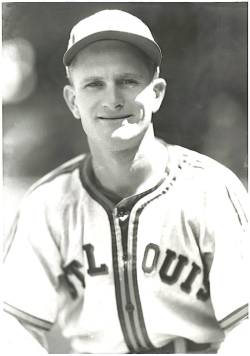
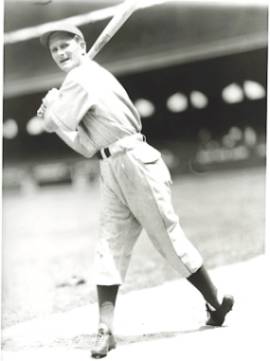
Hal Epps — Flychaser Supreme
 by Ronnie Joyner
When one looks back at the 1944 American League champion St. Louis Browns, their memories are probably dominated by images of pepperpot second baseman Don Gutteridge, hard-hitting shortstop Vern Stephens, clutch-hitting outfielder Al Zarilla, ex-marine hurler Sig Jakucki, or home run hero Chet Laabs. Others may see visions of guys like Ellis Clary, Mike Kreevich, Denny Galehouse, Jack Kramer, Mark Christman or George McQuinn. One member of that ballclub that probably slips through the cracks of almost everyone’s recollection, though, was a fleet-footed flychaser from Athens, Georgia.
Hal Epps. A role player at best in the Brownie dream season of 1944, Epps was a piece of the puzzle nonetheless — a piece worthy of remembering.
Harold “Hal” Epps, 90, passed away on Wednesday, August 25th, 2004 in Houston, Texas, trimming the roster of surviving members of the 1944 Browns to five. Epps’ 1944 teammates Frank Mancuso, Red Hayworth, Babe Martin, Floyd Baker and Don Gutteridge are the few treasured living links to the only team to win a pennant in the history of the Browns franchise.
Epps was born on March 26th, 1914 in Athens, Georgia, and he grew up playing both football and baseball. The six-footer accepted a football scholarship to the University of Georgia, but just one year into his college career he was convinced by a St. Louis Cardinals scout to jump to professional baseball.
Epps went to work in the talent-rich Cardinals farm system in 1935, logging time at Columbus, Rochester and Cedar Rapids. When his offensive numbers for those three clubs are combined, Epps hit well over .300 that season and, although not considered a power hitter, he socked 10 homers and 72 RBIs. 1936 saw Epps split time between Sacramento and Houston where he continued to progress.
After two more solid seasons with Houston in 1937 and 1938, Epps earned a September call-up from the Cardinals. It’s quite possible that Epps would have made it to the big leagues earlier had he been with a club other than the Cardinals, but to crack the lineup as an outfielder in 1938 you had to beat out Enos Slaughter in left, Terry Moore in center, and Joe Medwick in right. And, when one of those three was finally ready to be replaced, a fellow named Musial was the one doing the replacing.
Despite the slim chance of Epps ever winning a starting slot in that vaunted St. Louis outfield, the Cardinals wanted to take a look at the 24-year old. So on September 9th, 1938, Hal Epps, sporting number 17 on the back of his home Cardinals jersey, appeared in his first big league game, a 7-4 loss to the Cubs at Sportsman’s Park. He played outfield in 10 games through the remainder of the 1938 season, with seven more appearances as a pinch hitter. Epps picked up 15 hits in 50 at-bats for a respectable .300 average, not to mention one home run — the only one of his major league career — but he was be back in the minors in the spring.
The blond-haired, blue-eyed Epps spent most of 1939 and 1940 with Houston and made his way back to the big leagues for 11 games with the Cards in 1940. Those would be his last games in a Cardinal uniform, but he did take something of real value away from his time with the Redbirds — a close friendship with Terry Moore. In a true moment of irony, Epps named his son Terry after the man who was keeping him in the minor leagues.
Epps spent the entire 1941 season back with Houston where he had a fine season. He hit .295 with 16 triples and scored a league-leading 106 runs on a Buffs team that ran away with the Texas League title.
MinorLeagueBaseball.com ranked the 1941 Houston ballclub #65 in a list of the top 100 minor league teams of all time. Epps posted similar numbers with the Buffs again in 1942, but no call-up with the Cardinals came.
1943 brought a change for Epps, though, that boded well for his chances to get to the big leagues to stay — he joined the Toledo Mud Hens, the St. Louis Browns’ American Association affiliate. He made the most of his new opportunity hitting .301 with six home runs and 52 RBIs. In the field, “The Reindeer” used his blazing speed to gracefully cover tremendous amounts of outfield territory making countless dazzling catches. His all-around good play earned him a look from the Brownies in 1943, and in eight games Epps went 10-for-35 with 4 doubles.
The 1944 season was a breakthrough year for Epps as he played the entire campaign in the big leagues. He started the season with the Browns, but in 22 games hit only .177 and was released in June. It appeared as if Epps might have blown his best opportunity to stick in the majors, but the Athletics immediately picked him up and Epps had a new lease on his baseball life.
In 67 games with the A’s, Epps hit .262. He exacted a modicum of revenge against the team that had given up on him when he tripled and scored the winning run against the Browns at Shibe Park on August 16th. Epps’ season-ending total of nine triples was tied for 6th in the American League despite the fact that Epps only had 291 at-bats.
Although he was only with the Browns briefly in 1944, Epps made a lasting impression on his teammates. “Hal and I crossed paths twice — first when we played together with the Cardinals in 1938 and 1940, and then again with the 1943-44 Browns,” remembered former Browns and Cardinals infielder Don Gutteridge recently from his home in Pittsburg, Kansas. “He was a very, very good centerfielder and could cover a lot of ground because he could really run. At one time I was named fastest man in the National League, but I don’t know if I could run as fast as Hal even then! Hal was a little streaky with the bat, though. He might get 10 hits one week and then go 0-for his next 40. Everybody really liked Hal. He was a good guy and funny in an offbeat kind of way. I enjoyed playing with him.”
Frank Mancuso, one half of the Brownie catching tandem of 1944, mirrored Gutteridge’s sentiments. “I played against Hal in the Texas League, and I also played with him when he came up with the Browns. Let me tell you — he was a good outfielder, and he was really fast. Boy, could he run. Most important, of course, Hal was a real good guy and a good friend.”
A baseball card set was created back in 1996 that commemorated the A.L. champion 1944 Browns, and while Epps played only a small role in the team’s pennant, he, like each and every man to appear in a game for the ’44 Browns, was included in the production. Shortly following the card set’s completion, Epps wrote a letter to the project’s creator that gave insight to what his life was like at that time. Many years of playing baseball the only way he knew how — hard — had taken its toll on him physically, but his spirits were as bright as ever. “I have to print this — at age 82 my hand shakes,” he wrote. “I have to tell you, this card set was a nice thing you did, and I’m sure that the other old St. Louis Browns who are still alive will tell you the same thing. I watch ballgames on TV often, but I can’t go in person anymore — my health is not good. I have had three major surgeries in the past seven years — hip replacement, stomach and neck. I hobble around the house a little bit and that’s about it. Every day when I get out of bed I consider it a miracle, and I thank God for it. Thanks again for the nice cards. God bless.”
Epps’ play in 1944 may have been a stepping stone to many more years in the big leagues, but at the peak of his ability he went off to serve Uncle Sam. He missed all of 1945 and 1946 serving in the U.S. Army in the South Pacific during World War II, and never played in the big leagues again.
Rejoining the Houston Buffs following his military service, Epps enjoyed perhaps his best professional season in the 1947 campaign. The left-handed swinging and throwing Georgian hit .302 with six home runs and 84 RBIs, while continuing to play a stunning centerfield as Houston claimed another Texas League title. Epps, who had developed a reputation for delivering clutch hits, came up with the biggest bingle of his career on the last day of the ’47 season with the pennant on the line. Deadlocked with the Ft. Worth Cats in the bottom of the 9th, Epps singled, driving teammate Billy Costa home with the winning run — and taking the pennant by a half game. After capturing the pennant the ’47 club went on to capture the Dixies Series from the Mobile Bears of the Southern Association.
When his big season of ’47 did not lead to a major league contract, Epps may have seen the reality that he would never again make it to the show, but he loved playing ball and he didn’t quit. He played five more seasons of minor league ball before turning his attention to managing a semi-pro team. Later, Epps joined ARMCO Steel where he worked in security for 25 years.
“From my own experience watching Hal Epps play for the Houston Buffs, I will tell you — the guy could go get ’em,” said Browns Fan Club member and Buffs historian, Bill McCurdy following Epps’ death. “He had that Pete Reiser tendency of crashing into fences to make catches. He was also the best clutch-hitter on the ’47 Buffs club.”
Epps was a very popular player because of the all-out effort he always put forth on the field as well as the gentlemanly way he conducted himself. In spite of the fact that it has been over 50 years since he played his last professional ball game, Epps was not forgotten and still received an average of three fan letters a week. Shortly before his passing, Epps’ daughter read one aloud. The fan simply wanted to know what he considered to be his biggest thrill.
“Just playing ball,” was Epps¹ answer.
Hal Epps leaves behind Elizabeth, his wife of 56 years, his son Terry, two daughters — Beverly and Connie, several grandchildren and great grandchildren, and many fans — mostly Houston Buffs fans. But because he suited up in brown and orange in a very special year for the OTHER St. Louis baseball club, Hal Epps will be in the hearts and minds of Browns fans as long as they remember the pennant of 1944.