Fact of the Day …
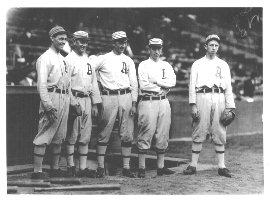
by Buff (Bill McCurdy)
“Sucker Punch.” As in life, we should never take anything for granted in baseball. For example, - how many of you have assumed that the home team has always batted last?
You’d almost be right, except for one thing, - up until 1950, when MLB changed the rule to fix it so that visitors always batted 1st, the home team had the pre-game option of batting in either the top or bottom of the inning.
I can’t remember ever seeing or listening to a game in which the home team batted first, but the strategy (if you want to call it that) apparently was more popular during the first two decades of the 20th Century. The only thing I can see is that a manager of a good hitting team may have thought his club might be able to demoralize a foe by batting first and scoring often.
At any rate, it was not a common occurrence, but it is relevant to today’s story. On June 27, 1911, in a game at Boston, the home town Red Sox were batting first in a game against the visiting Philadelphia Athletics.
As the game moved to the bottom of the 8th, something very bizarre was about to happen. As Red Sox hurler Ed “Loose” Karger was throwing a few warm-up pitches to rookie catcher Les Nunamaker, the next A’s batter, Stuffy McInnis, stepped in and swung at one of the pitches.
The ball took off for center field and started rolling. The Boston outfielders had yet to take their positions. McInnis then took off running around the bases as Karger and Nunnamaker stood there with “what goes on?” looks on their faces.
When McInnis crossed the plate, the umpire signaled “safe,” - the run counted! Needless to say, the Red Sox jumped on the umpire like frogs on a June Bug. They immediately protested the game to AL President Ban Johnson on the grounds that two Philadelphia players were still leaving the field and were still in fair territory when McInnis struck his blow. Johnson denied the protest.
How could something so apparently unfair be allowed to happen? The umpire had not even given the signal that time was in!
Easy answer for AL President Johnson. The AL had recently made warm-up pitches between innings illegal in an effort to speed up the games. AL owners had been concerned about the length of games, - some were taking about two hours to play.
McInnis, a wiley veteran who knew the new rule, saw that he had nothing to lose by stepping in and hitting against the pitcher. The umpire supported McInnis as an object lesson to the pitcher. i.e., “You shouldn’t have been throwing those pitches, anyway!”
In baseball, as in life, not all things are fair.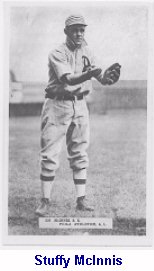
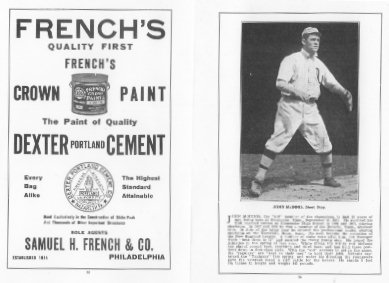
John McInnis, Short Stop.
John McInnis, the “kid” member of the champions, is just 20 years of age, being born at Gloucester, Mass., September 19, 1890. He received his first baseball tuition at Gloucester High School in 1906 and 1907, playing shortstop. In 1907 and 1908 he was a member of the Beverly, Mass., amateur club. In July of the latter year he entered the professional ranks, playing shortstop on the Haverhill, Mass., team. He soon became the sensation of the New England League. A number of clubs were after him, but Manager Mack “beat them to ti” and secured the rising young star. He joined the Athletics in the spring of last year. While filling the utility roll McInnis has played second base, shortstop and third base, and has held these positions down in first-class style. With the “kid” anxious to get in the game, the “regulars” are “kept on their toes” to hold thier jobs. McInnis captained the “Yanigans” this spring, and under his direction the youngsters gave the veterans many a stiff battle for the honors. He stands 5 feet 9 1/2 in height and weighs 145 pounds.
Actual excerpt from the A’s 1910 Championship season Souvenir program.