Dick Fowler: A Pitcher of Note
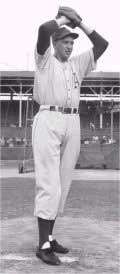 By David M. Jordan
I saw Dick Fowler pitch for the A’s on numerous occasions, but the one that always sticks in my mind is the one I didn’t see. It was Sunday, September 9, toward the end of the 1945 season. I planned to go down to Shibe Park that day, to see the A’s and Browns play a doubleheader; I tried to go to Sunday doubleheaders as often as possible, either the A’s or the Phillies, because what after all could beat seeing two games for the price of one? Even though the Sunday curfew did some strange things to the late innings of the second games.
This Sunday morning, though, was rainy and drizzly, and prospects for an enjoyable day at the park were somewhat cloudy. My A’s weren’t going anywhere (they would finish last, 34 1/2 games behind the pennant-winning Tigers, 17 behind the seventh-place Red Sox), and they had a pitcher I’d never heard of going in the second game, not one of the regular starters like Bobo Newsom, Russ Christopher, or Jesse Flores. So I decided to forego the trip to Shibe Park in favor of doing whatever other things there were that appealed to a ten-year-old boy.
What a mistake that was! For that unheralded pitcher, a veteran of three years’ service in the Canadian army named Dick Fowler, put together the game of his life in the nightcap of that long-ago doubleheader. The St. Louis Browns were no pushovers in 1945; they had won their only pennant the year before and in ’45 they would finish third. They had hitters like Vern Stephens, George McQuinn, Don Gutteridge, and Mike Kreevich, so they could swing the bats. The Browns also carried the one-armed outfielder Pete Gray, who hit only .218, but Pete didn’t play in Fowler’s game.
The Browns simply could not touch Fowler. Inning after inning they went three up and three down, with only an occasional base on balls giving them any semblance of an attack. Unfortunately, the A’s hitters were having little better success against John “Ox” Miller, the St. Louis pitcher, so both clubs piled up a lot of scoreless innings. For Dick Fowler, it brought back haunting memories of an earlier game against the same opponent, from June 5, 1942, when he hurled another masterpiece, only to lose, 1-0, when the Browns pushed across a run in the sixteenth inning.
Extra innings (and the curfew) loomed when the A’s came to bat in the bottom of the ninth, with the game still scoreless. But Dick Fowler’s salvation came in the form of a triple by A’s outfielder Hal Peck, followed by a solid run-scoring single off the bat of second baseman Irv Hall, and the classic was complete. A no-hit, no-run victory and a huge boost for Mister Mack’s postwar hopes.
Richard John Fowler was born in Toronto on March 21, 1921, and he grew up to be a strapping young man of six feet four and a half inches, weighing 215 pounds. A righthander all the way, he got his start in professional baseball at Cornwall in the Canadian-American League in 1939, pitching in three games before being sent down to Batavia in the Pony League where he posted a record of 9-11. In 1940, the young pitcher was back in the Canadian-American League, winning 16 and losing ten for Oneonta, New York. He grew so attached to Oneonta that he later made it his permanent home. Fowler’s work there earned him a late-season callup to Toronto, in the International League, where he won his only start. The next season Dick Fowler was a mainstay of the Toronto staff, with a 10-10 record and a 3.30 earned run average, and he was purchased by the Athletics.
In September 1941, Dick Fowler pitched four games for the A’s, winning one, losing two. One of those losses came on the last day of the season, against the Boston Red Sox. Ted Williams, hoping to get his average above .400, faced Fowler for his first two at bats of that final twin-bill, touching Dick for a single and a long home run as he ran his average up to .406.
The next season Fowler was a regular for the last-place A’s, with a mark of 6-11, before entering the service. His return from the war, as we have seen, was spectacular. In 1946, with another cellar-dweller, the tall young righthander was 9-16, with a fine e.r.a. of 3.28. As the A’s fortunes improved, so did Dick Fowler’s. The easy-going, likable hurler became one of the bulwarks of Connie Mack’s pitching staff over the next three years, when the team finished fifth-fourth-and-fifth. In 1947, he was 12-11 and 2.81, in 1948 15-8 and 3.78, and in 1949 15-11 and 3.74, along with four shutouts.
Fowler put these records together even though chronic bursitis in his shoulder made throwing a baseball painful. In 1950, as the club fizzled, the bursitis worsened and his record was 1-5 in only eleven games. The next season, it was 5-11 in 22 games. In 1952, Fowler was 1-2 in just eighteen games, and it was time to call it quits. For his big league career, he was 66-79, with the satisfaction of knowing he had been a regular starter on an American League pennant contender. His no-hitter was the first in the big leagues ever thrown by a Canadian hurler.
Dick Fowler retired to his home in Oneonta, where he died at the early age of 51 on May 22, 1972. We at the A’s Society were honored last year with a visit by his granddaughter Veronica Gamper, a resident of Austria, and we are pleased to note the pitching exploits of Dick’s grandson, Khalid Ballouli, who was drafted by the Milwakee Brewers. It must be the genes.


