Dave Philley’s 50 Year Old Pinch Hitting Record
 By Cort Vitty
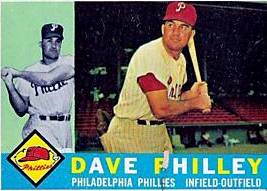
The 2009 season opened with the 50th anniversary of switch hitting Dave Philley’s record of 9 consecutive pinch hits. Coming off the bench, Philley ended 1958 with 8 consecutive safeties for the Philadelphia Phillies. On April 16th 1959, in his first plate appearance of the season, Philley laced a sharp double, to establish a National League record of 9 pinch hits in a row. Philley’s role as a pinch hitter evolved after many years as a dependable everyday player.
David Earl Philley was born in Paris Texas on May 16th 1920. As a youngster, he threw right and batted left, until a broken left arm made it impossible to swing from his natural side. He learned to hit right-handed and became adept enough to continue switch-hitting after the arm healed. Dave was a high school standout in baseball, football, track and boxing.
The 6’, 188 lb Philley was signed in 1940, by the Chicago White Sox as a catcher. When Dave came up for a brief trial late in 1941, manager Jimmy Dykes cautiously inserted him into the lineup against the Senators. A Washington scribe reported: “A rookie named Dave Philley played left field for five innings and escaped without serious injury.” As an outfield newcomer, Dave completely missed one ball hit in his direction. Later a scorching line drive barely missed his head, prompting Dykes to “remove the youngster before being charged with manslaughter.” Philley carried the tattered news clipping in his wallet for many years.
After the 1941 season, Dave entered the Army and served until the end of WWII. He returned to the majors late in 1946, hitting .363 in 17 games for the pale hose. In 1947 he became the White Sox regular center fielder, hitting .258 in 143 games; his 21 stolen bases were second best in the league. A .287 mark in 1948 was followed by a .286 average in 1949. Dave started 1950 solely as a left-hand batter, realizing he hit about 100 points higher from the port side. The experiment ended when New York left-hander Tommy Byrne plunked him 3 times during a contest at Yankee Stadium. Dave resumed switch hitting and finished the season with a .242 average and a career best 14 home runs.
Former manager Jimmy Dykes was running the Philadelphia A’s in 1951, and acquired Philley as part of a three team deal. By now, Dave had become an accomplished fly hawk and his field boss had no qualms about his defensive skills — or his ability to defend. On numerous occasions, Dave saved his diminutive manager from surly pitchers and argumentative catchers. When benches cleared, Dave would intervene with a gruff: “All right, you want to fight somebody – fight me. Let him alone. He’s an old man.” “Well, that took me down a peg or two.” Dykes recalled. The hard playing Philley confidently stated, “I never look for trouble.” But teammates and opposition alike agreed he never ran from it either.
Dave posted identical .263 averages in 1951 and 1952. He enjoyed his most productive offensive season with the A’s in 1953, when he hit .303 in 157 games. The strong armed Philley led league outfielders in assists 3 times during his AL tenure. Dykes noted: “He has always been a sort of a ballplayer’s ball player, faster than most and with a stronger arm than the majority.” Philley practiced hard to become an exceptional bunter and usually led the A’s in sacrifices.
As a holdout after the ’53 season, the A’s couldn’t meet Dave’s salary demands, resulting in a trade to Cleveland prior to the 1954 season. He proceeded to have the worst year of his career, hitting only .226 for the pennant bound Indians. Manager Al Lopez put some prospective into the disappointing numbers. “I never saw so many screaming line drives hit directly at so many people.” Dave would make the only World Series appearance of his career that October. Further down in the standings, the 1954 Orioles finished a dismal 7th, in their inaugural season in Baltimore.
The Baltimore Orioles opened the 1955 the season with a 20-53 record under new manager Paul Richards. Desperate to add offensive punch, Richards was surprised to find Philley available and promptly plucked the big Texan off the waiver list; the acquisition of Philley immediately sparked the Orioles. He went on to hit .299, primarily as a left fielder and third baseman. After his arrival, the team improved to a 37-44 record, earning him Most Valuable Oriole honors, as voted by the media. Traded back to the White Sox for 1956, Philley added first base to his growing resume of defensive positions. He would next be shuttled to the Detroit Tigers in 1957, where he hit .283 overall, but logged a .414 average off the bench.
Philley made his initial National League appearance, when sold to The Philadelphia Phillies prior to the start of the 1958 season. Acquired specifically as a pinch hitting specialist, the 38 year old was still agile enough for outfield or first base duties. He feasted on NL pitching to the tune of a .309 overall average. The hard charging veteran broke his nose on May 17th, when he dove into the first base stands chasing a foul ball; the collision kept Philley out of the starting line-up for 6 weeks. He ultimately pounded 18 safeties as a pinch hitter, including 8 hits to end the season.
When his streak was extended to 9 in a row in 1959, Philley elaborated on his approach to pinch hitting during a 1959 interview with Ed Wilks of the Associated Press. “I walk to the plate with all the confidence in the world. I figure I’ve got only one shot at it. I relax as much as possible, yet manage to bear down. Of course it helps to know the opposing pitchers. I study them as much as I can.”
A productive .291 mark for the 1959 Philadelphia Phillies, resulted in his sale to the San Francisco Giants after the start of the 1960 season, where he hit only .164 in 39 games. He was reunited with the Orioles and old manager Paul Richards on September 1st 1960. Although obtained specifically for pinch hitting, the veteran was immediately pressed into the starting lineup, when left fielder Gene Woodling suffered an injury. Dave hit .265 in 14 games.
In 1961, the Baby Birds of Baltimore won 95 games and finished a respectable third in the AL standings. Philley contributed 24 safeties to establish an American League record, while posting an overall .250 average in 99 games. Despite his record setting pinch hits and.299 average off the bench, he was released by the Orioles at the end of the season. By then, old boss Paul Richards was hired away from the Orioles to develop the expansion Houston Colt-45’s. He signed Dave as a free agent in 1962, and subsequently traded the veteran to the Boston Red Sox, where Philley wrapped up his big league career. Dave went on to manage in the Houston organization and also served as an instructor and scout in the Red Sox system.
Overall, his 1700 hits in 6296 at bats produced a lifetime batting average of .270, with a total of 84 home runs. Philley, a competitor on and off the field, strived to improve every aspect of his game. A believer in top physical conditioning, he became a proponent of finger tip push ups as taught to him by Ted Williams. He always got plenty of sleep and strictly adhered to training rules. The strongest drink he’d consume was soda pop and his only admitted vice was smoking an occasional cigar. In retirement, Philley became an active community leader and held several elected posts, while residing on his 557 acre cattle ranch east of Paris, Texas.
Source List:
The New York Times; The Paris (Texas) News; The Salisbury (Maryland) Times; The Sporting News; The Washington Post; www.astroland.net; www.baseball-almanac.com;
www.baseball-reference.com