COLBY JACK COOMBS
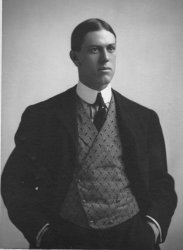 by Dale B. Smith
In the early years of our lives June was a special time. In our childhood it meant the beginning of summer vacations. Later, it meant graduation. Our graduation was a chance to shine, if only for a few seconds, to hear our names called and to walk across a stage, diploma in hand, perhaps to the applause of a few admirers. Afterwards, we may have even wondered about the possibilities of fame and fortune.
Few of us, however, would have imagined that, 100 years after our graduation, our school would be remembering and celebrating the day we took hold of that rolled parchment. But that is exactly what happened last June to a chemistry major that walked the stage back in 1906. But John Wesley Coombs was not remembered for any scientific discovery. At a small, academically-oriented school in Maine named Colby College, John Coombs was remembered for being “Colby Jack”.
Born in Legrand, Iowa in 1882, John moved with his family to Maine when he was five and later enrolled at Colby College with the intent of becoming a chemistry teacher. Fate interfered, however, when Philadelphia Athletics manager Connie Mack visited the Waterville campus in 1905. John Wesley, it turned out, had a pretty good side arm delivery for the Colby College baseball team and was already known on campus as “Iron Man Jack”. After signing with the A’s for $2,400, Jack became one of just a few major league players who had attended college. He soon became known as “Colby Jack” and was on his way to becoming one of the greatest ambassadors the little Maine college has ever had.
Within three weeks after graduation, Jack Coombs became a starting pitcher for the Athletics, promptly shutting out the Washington Senators. In his first season, the 24 year old was impressive enough with a 10-10 season and a 2.50 ERA. What was most impressive, however, was his September 1st start. In a 4 hour, 47 minute game against the Boston Red Sox, Colby Jack won a complete game, 24 inning contest, 4-1. Whether known as “Iron Man Jack” or “Colby Jack”, John Coombs had already made a name for himself in his first season.
During the 1907-1909 seasons, Jack was good but not spectacular, winning a total of 25 games. It was in 1910, however, that “Colby Jack” would become a household name. The 28 year old threw 353 innings, pitching 35 complete games in 38 starts. His 31 victories is an Athletics franchise win record, tied only by Lefty Grove in the 1931 season. That year Jack also established all time A’s records for shutouts with 13 and lowest ERA with 1.30. With 224 strikeouts, he arguably had the best pitching year in the Athletics’ 105 year history.
As good as his 1910 regular season had been, he saved the best for last, pitching in the 1910 World Series against the Chicago Cubs. In that series, manager Connie Mack would use only two pitchers. That’s right, two starters and no mid- relief pitchers, no closers. Mack opened with Chief Bender on October the 17th with Bender getting the victory, 4-1. On October 18th Jack Coombs beat the Cubs 9-3. Only two days later, Mack went with Coombs again with Coombs besting Chicago 12-5. After the Cubs beat Bender 4-3 on the 22nd, Mack brought Coombs back on the 23rd, his third start in five days. Pitching in Chicago, Colby Jack whipped the Cubs, 7-2. The Philadelphia Athletics won their first World Series. Colby Jack won three of the four games, pitching 27 innings with a 3.33 ERA while hitting .385, behind only Frank Baker and Eddie Collins.
1911 was another good year for Coombs, winning 28 games. Winning another pennant, the A’s faced the New York Giants in the World Series. Jack won his only start in Game 3. In that game he benefited from Frank Baker’s home run in the ninth that earned Baker his “Home Run” nickname.
Jack’s 1912 year with 21 wins appeared to indicate that the 30 year old was going to be dominant for a while to come. But it was not to be. Severely stricken with typhoid fever in 1913, Jack pitched only four games for the A’s in the 1913-1914 seasons.
Jack recovered for the 1915 season but was now pitching for the Brooklyn Dodgers. He pitched well for the Dodgers in 1915 and 1916, winning another World Series game for the Dodgers in 1916. Retiring in 1920, Colby Jack had won a total of 159 games, with 80 of those wins coming with the Philadelphia Athletics between 1910 and 1912.
After Jack left the major leagues, he tried his hand at coaching at the college level. In 1929 he started coaching at Duke University and stayed for the next 23 years before retiring in 1952. His Duke legacy is a 381-171 record before advancing to the College World Series in 1952. For his efforts, both Duke University and Colby College have baseball fields named after Jack.
But Maine and Colby College were always close to his heart and “Colby Jack” has obviously remained in Colby College’s heart. 100 years after the chemistry major walked off the graduation stage, Colby College again celebrated his graduation in June 2006. Even a Special Collection at the Colby College library still maintains Jack’s Colby College chemistry notebooks. For most of us, our graduation applause lasted a few seconds. For “Colby Jack” Coombs, the applause has lasted 100 years.